What is the Paper About?
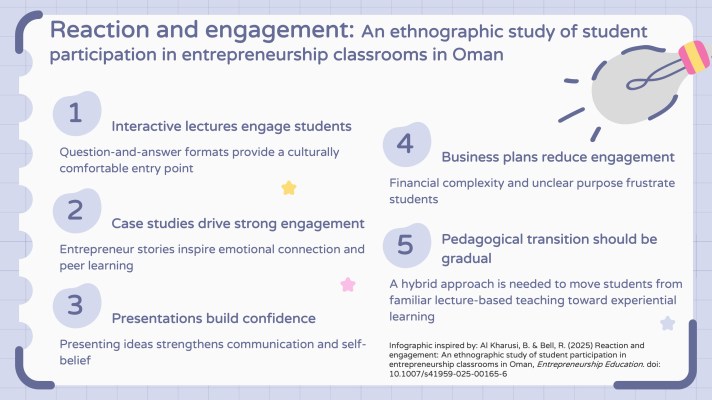
The study provides an in-depth ethnographic analysis of how Omani university students engage with and react to the pedagogical methods used in the country’s mandatory entrepreneurship education curriculum. Drawing on 80 hours of classroom observations across two online classes and 11 follow-up interviews, the research examines student behaviours, interactions, emotions, and learning experiences across four teaching methods: lectures, case studies, presentations, and business plan development. The findings show that interactive lectures and Q&A exchanges stimulate participation, case studies inspire and emotionally connect students to entrepreneurial ideas, and presentations build confidence and communication skills. In contrast, business plan development generates confusion, low engagement, and negative reactions, particularly due to challenges with financial components and limited understanding of purpose. Through a fine-grained, interpretive account of classroom dynamics, the paper illuminates how different elements of traditional and progressive pedagogy function in practice within an educational system undergoing reform.
Why is it Important?
The study demonstrates how pedagogical reform in transitional education systems requires careful sequencing, contextual sensitivity, and hybrid models that bridge traditional and progressive practice. By showing that students engage most effectively with interactive lectures, narrative-driven case studies, and confidence-building presentations, but struggle with premature or overly technical tasks such as business plan writing, the research highlights the risks of transferring global EE practices into contexts where student readiness, familiarity, and cultural norms differ. The findings offer actionable insights for policymakers, curriculum designers, and educators seeking to align entrepreneurship education with Oman Vision 2040 and to support a more effective shift from teacher-centred instruction to constructivist, student-centred learning. More broadly, the work contributes empirically grounded evidence to international debates on contextualising EE, managing pedagogical transitions, and designing curricula that genuinely cultivate entrepreneurial mindsets, skills, and behaviours rather than reproducing mismatched or ineffective practices.
 Robin Bell